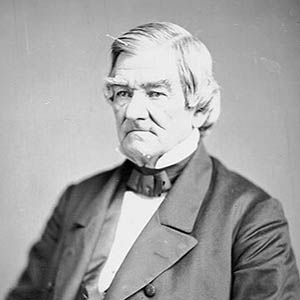
John Ross / Koo-wi-s-gu-wi
John Ross served as the Principal Chief of the Cherokee Nation from 1826-1866, serving through trying times for the Nation, such as the Trail of Tears and the Civil War.
Ross was born to a Cherokee mother and a Scottish father. Throughout his early life, he learned both English and Cherokee. His career began early, in 1811, when he was appointed Indian Agent. He served as Adjutant of a Cherokee Regiment under Andrew Jackson during the War of 1812.
In 1816, Ross went on his first trip to Washington D.C. where he became the principal negotiator because he was bilingual. In 1817, he was elected to the Cherokee Council and became the president in 1818. Then in 1824, he petitioned the United States Congress for a redress of Cherokee grievances, making the Cherokee the first tribe to do so.
One thing Ross was adamant about was that the Cherokee should not have to move to Indian Territory. The Cherokee were split into two sides, forming two political parties. His party was called the National Party and his opposition was called the Treaty Party. The Treaty Party was the one to sign the Treaty of New Echota on December 29, 1835. This treaty forced the Cherokee to move by 1838. The American Government upheld and supported this treaty, John Ross did not. Nonetheless, the Cherokee were forced from their homeland. One-forth of the Cherokee would die on the Trail of Tears, including John Ross’s wife.
Leading up to the Civil War, the National Party became the Union Party and the Treaty Party became the Southern Party, and one of their main divisions was slavery. Ross originally preached neutrality in the war, but he eventually signed a treaty with the Confederacy.
Ross was married twice in his life. His first wife was Quatie Brown Henley (1790-1839) and his second wife was Mary Brian Stapler (1826-1865). He had seven children.
Ross died in 1866, on a trip to Washington D.C. where he was negotiating a Reconstruction treaty.